Prasanta Paul |
WHEN did homo sapiens start using words or to be specific – a language – for communication ?
An intriguing question indeed ! Researchers probing deep into the genesis of the emergence of human language have now stumbled upon an important facet of pre–historic tradition that might rewrite the hitherto established history.

■ Photo credit | Shutter stock
A research paper published in Massachusetts Institute of Technology (MIT) sheds a very significant and revealing light on this question — since when Homo sapiens, our species that are nearly 230,000 years old, had started communicating through a sort of language.
The cognitive capacity for human language was present at least 135,000 years ago. The study, titled “Linguistic capacity was present in the Homo sapiens population 135 thousand years ago,” indicates that actual social use of language likely began around 100,000 years ago
The paper published in Frontiers in Psychology suggests that the cognitive capacity for human language was present at least 135,000 years ago. The study, titled “Linguistic capacity was present in the Homo sapiens population 135 thousand years ago,” indicates that actual social use of language likely began around 100,000 years ago.
The research is preliminarily based on a varied form of evidence, stretching from a wide vista of fossils to cultural artifacts. However, the researchers have travelled beyond and inferred that human languages, irrespective of geographical boundaries, have a common origin.
Yet, the crucial question that haunted them is how far back in time Homo sapiens had begun spreading around different parts of the world.
Having delved deeper into genomics data, the researchers led by Shigeru Miyagawa, an MIT professor and co–author of a new paper summarizing the results, collated geographic divergence of early human populations.
Researchers who intensely analysed the extent of genetic variations coming up in the studies, reached a point of unanimity on estimating the time at which Homo sapiens still formed one regionally undivided group
And the result was a thrilling revelation–cum–discovery; it all suggests an initial regional branching of humans about 135,000 years ago.
“The logic is very simple,” explains Miyagawa, a professor emeritus of linguistics and the Kochi–Manjiro Professor of Japanese Language and Culture at MIT, “Every population branching across the globe has human language, and all languages are related.”
“I think we can say with a fair amount of certainty that the first split occurred about 135,000 years ago, so human language capacity must have been present by then, or before,” MIT News quoted him as saying.
The new paper examines 15 genetic studies of different varieties, published over the past 18 years: Three used data about the inherited Y chromosome, three examined mitochondrial DNA, and nine were whole–genome studies.
After the emergence of Homo sapiens, groups of people subsequently moved apart geographically, and some resulting genetic variations have developed, over time, among the different regional subpopulations, MIT News said. The researchers who intensely analysed the extent of genetic variations coming up in the studies, reached a point of unanimity on estimating the time at which Homo sapiens still formed one regionally undivided group.

■ Photo credit | MIT News
Thus, thorough research into the studies collectively provides one overwhelming converging evidence, revealing the time when the actual geographic splits began taking place.
Because of the availability of a wealth of published data at present, it became quite easier for the researchers to coalesce them together and arrive at the likely time of the first split 135,000 years ago. In contrast, the previous scholars probing this in 2017 had little genetic studies to base upon.
“…..quantity-wise we have more studies, and quality-wise, it’s a narrower window [of time],” says Miyagawa. According to him, all human languages, many linguists also believe, are demonstrably related to each other and the same aspect Miyagawa has examined in his own work.
“Human language is qualitatively different because there are two things, words and syntax, working together to create this very complex system. No other animal has a parallel structure in their communication system. And that gives us the ability to generate very sophisticated thoughts and to communicate them to others,” avers the MIT scholar.
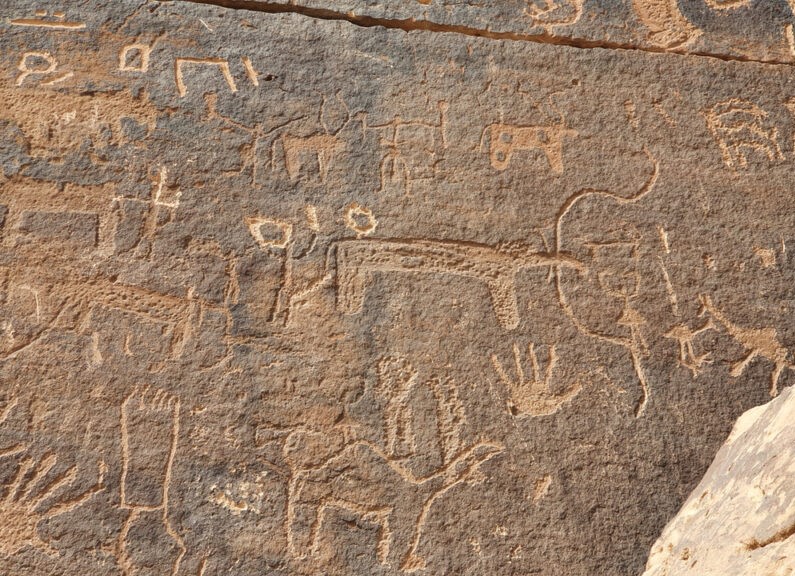
There was a widespread appearance of symbolic activity, archaeological records reveal, from meaningful markings on objects to the use of fire to produce ochre, a decorative red color. And language was the trigger for modern human behavior, researchers have pointed out in the paper.
The other co–authors include Rob DeSalle, a principal investigator at the American Museum of Natural History’s Institute for Comparative Genomics; Vitor Augusto Nóbrega, a faculty member in linguistics at the University of São Paolo; Remo Nitschke, of the University of Zurich, who worked on the project while at the University of Arizona linguistics department; Mercedes Okumura of the Department of Genetics and Evolutionary Biology at the University of São Paulo; and Ian Tattersall, curator emeritus of human origins at the American Museum of Natural History. ■
Prasanta Paul served Deccan Herald as the Chief of Bureau, Calcutta for nearly two decades before switching to work with various TV channels such as Al-Jazeera, CNN, German TV and CBS. Mr. Paul who accompanied former Prime Minister Atal Behari Vajpayee on his overseas tour of Singapore and other Asian countries, travelled extensively to Bhutan, Sikkim and Darjeeling besides other Northeastern states.