Dr Manas Das |
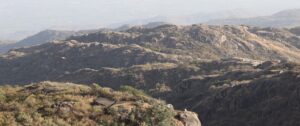
THERE seems to be a temporary lull among environmental activists and civil society as the Supreme Court on 29th December, 2025 stayed its own November 20 order that had relaxed mining norms for the Aravalli Range that stretches across 670–800 kilometres from Gujarat through Rajasthan to Haryana and Delhi National Capital Region (NCR).
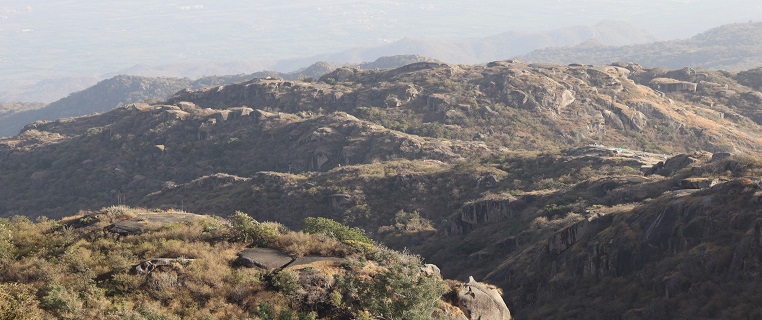
■ Aravalli Range
The simmering discontent and serious concerns over ecological imbalance and depleting green cover had reached a flashpoint with the previous SC order stating that only the hills with an elevation of 100 metres or more from their local terrain be deemed as Aravalli Hills. Two or more such hills within 500 metres of each other along with the land between them will be considered an Aravalli range.
Consequently, other hills of the region with lesser height would lose the hill status and, critics fear, would succumb to indiscriminate mining, construction and commercial activities that could potentially impact the ecology and climate of the region in an irreversible way.
The majority of the activists behind the ‘Save Aravalli’ campaign has been unanimous on one important point which is — “The Aravalli range should not be defined by its height alone, but by its ecological, geological and climatic role.”
Not only for being very old, the Aravalli hills, composed of ancient metamorphic rocks like granite, schist and gneiss, have been playing a tremendous role in safeguarding the country from many ecological disasters
Origin of ‘Aravalli’
The name “Aravalli” comes from Sanskrit, meaning “Line of Peaks”. Not only for being very old, the Aravalli hills, composed of ancient metamorphic rocks like granite, schist and gneiss, have been playing a tremendous role in safeguarding the country from many ecological disasters. Had the Hills not been there, the Thar Desert would have reached the doorstep of the national capital and the climate of that region would have been drastically different.
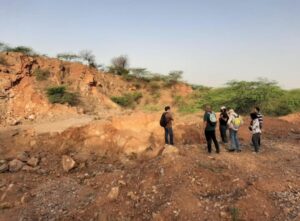
Instead of being a mere geological formation, the Aravallis are a geographical entity that has quietly shaped water, climate and human settlement across northwestern India for thousands of years. As the SC stay comes into effect, no permission shall be granted for mining, whether it is for new mining leases or renewal of old ones, in the Aravalli Hills and Ranges.
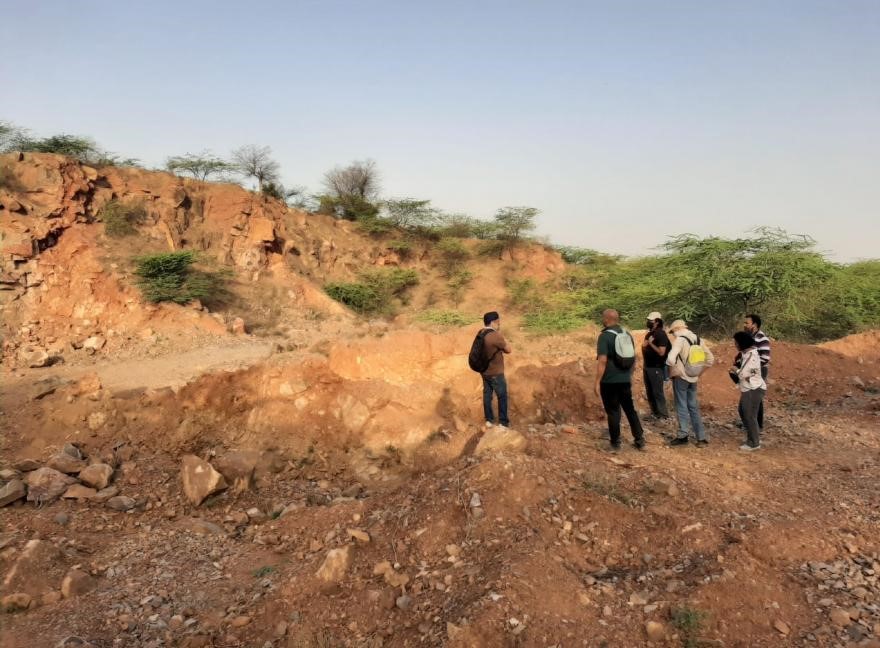
■ Illegal mining continues unabated at several locations in the Aravallis | NewsClick
Why the ‘Save Aravalli’ cry ?
But why is there an outcry to save Aravalli ? To understand that, we need to probe deeper into some important facts–cum–issues regarding these ancient hills. The Aravalli Range is one of the oldest mountain systems in the world and the oldest in India, dating back nearly 2,000 million years to the Paleoproterozoic era. The formation took place during the Aravalli–Delhi orogeny due to tectonic plate collisions. What remains today are highly eroded parts of a much larger prehistoric mountain system that has been reduced to its present form over millions of years through vagaries of nature and erosion.
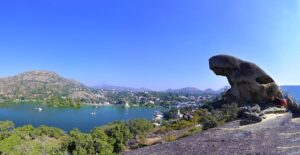
The highest peak of the range is Guru Shikhar Peak on Mount Abu (1722 metres). The Aravallis act as a natural barrier against the Thar Desert’s move to expand towards north–western India. These hills resist desert sand to drift toward fertile plains, protecting them from worsening air pollution and dust storms. Located in a semi–arid region that records an average annual rainfall of 500–700 mm, the Aravalli range acts as a major watershed dividing drainage between the Bay of Bengal and the Arabian Sea.
Aravalli range, described as “Earth’s oldest surviving mountain system”, is crucial for agriculture too as it regulates climate, blocks desertification and sustains water systems. It helps in guiding monsoon moisture for regional rainfall and recharging groundwater for irrigation
The importance of Aravalli does not end here. The Aravalli landscape supports dry deciduous forests, grasslands and wetlands with a unique mix of Saharan, Peninsular and Oriental biodiversity. It is to be noted that this hill range houses 22 wildlife sanctuaries and three tiger reserves and acts as a habitat for such endangered species as tiger, leopard, Indian wolf, sloth bear and Great Indian Bustard.
The Aravalli range, described as “Earth’s oldest surviving mountain system”, is crucial for agriculture too as it regulates climate, blocks desertification and sustains water systems. It helps in guiding monsoon moisture for regional rainfall and recharging groundwater for irrigation.
The Aravalli range supports rainfed farming (bajra, mustard, pulses) and livestock–dependent economies, especially in the Aravalli district, Gujarat and Rajasthan. The Aravalli region is highly rich in minerals with over 70 commercially valuable minerals like zinc, lead, silver, tungsten, marble and granite. Mining has emerged as a key economic activity, particularly in Rajasthan which accounts for around 80% of the range.
Aravalli’s Threat
The Aravalli faces threat due to industrial development and urban pressure in its terrain. Due to its strategic location, the Aravalli belt hosts major industrial and urban clusters such as Gurugram, Faridabad, Jaipur, Alwar and Ajmer. A host of industries ranging from IT and textiles to automobiles, chemicals and steel are also supported by the hill range. The Aravalli region does not lack in cultural significance either.
The mountain range houses such UNESCO World Heritage Sites as Chittorgarh and Kumbhalgarh forts. The Aravalli is also home to major religious centres such as Pushkar, Ajmer Sharif, Mount Abu and Ranakpur making it sacred to Hindu, Islamic and Jain traditions and reinforcing its civilisational value.
Internal Forest Survey of India assessment shows that the 100–metre threshold excludes over 90% of the Aravalli range from the new definition. But the Centre opined that the November verdict did not dilute Aravalli protection nor did it allow large–scale mining
The degradation of the Aravalli is not a recent phenomenon. Much like other mountain systems, the Aravallis have experienced severe deforestation, mining, urbanisation and grazing pressure. Several hills have disappeared; forest cover has declined sharply and rainfall has come down drastically. As a result, the region has witnessed soil erosion, aquifer damage, desert gap expansion and fatal air pollution, affecting Delhi–NCR belt.
The November SC verdict adopted a uniform definition of the Aravalli Hills, banned new mining leases and mandated a sustainable mining plan banning mining in core areas, eco–sensitive zones, the reserves and wetlands, permitting exceptions only for atomic minerals, critical minerals and minerals listed in the Seventh Schedule of the MMDR Act 1957.
A Key Redefinition by SC
While in other aspects the earlier Supreme Court verdict appeared like a calibrated approach which even the recent stay order highlights, it is the 100–metre redefinition mark that has triggered public protests and political reactions. Critics are of the view that 100–metre rule may exclude large areas, risking groundwater, biodiversity and desertification control underscoring the need for landscape–level restoration.
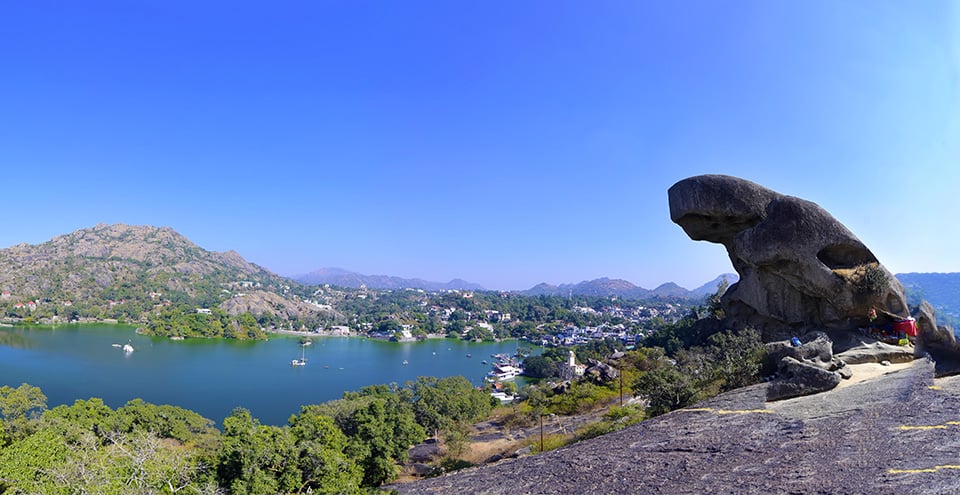
■ Mount Abu
Even an internal Forest Survey of India assessment shows that the 100–metre threshold excludes over 90% of the Aravalli range from the new definition. But the Centre opined that the November verdict did not dilute Aravalli protection nor did it allow large–scale mining. The Centre feels that illegal mining is the greatest threat and stronger monitoring and enforcement were necessary including use of drones and surveillance technologies.
The Environment Minister stated that only about 2% of the 147,000 square km of the Aravalli range could potentially be mined, and that too only after detailed studies and official approval.
Measures Required to Save the Range
As the Supreme Court stay gives relief to countless countrymen, certain concrete steps need to be taken to save the range and surrounding regions from manifold disasters. The government has to undertake comprehensive, standardized mapping of hills, ranges, slopes, valleys, recharge zones and wildlife corridors, both in Aravalli and elsewhere, using authoritative datasets.
We must not forget that the Himalayas too face large–scale exploitation and degradation due to urbanisation, industries, tourism and infrastructure development projects. As for Aravalli, proper monitoring of mining activities should be strengthened through institutional coordination and advanced technology-based instruments.
Much like other mountain systems, the Aravallis have experienced severe deforestation, mining, urbanisation and grazing pressure. Several hills have disappeared; forest cover has declined sharply and rainfall has come down drastically. As a result, the region has witnessed soil erosion, aquifer damage, desert gap expansion and fatal air pollution
The ecosystem of the area should also be protected through adoption of indigenous restoration systems like ‘taankas’, ‘jhalaras’ and ‘talab–bandis’ which strengthen watershed management in the Aravalli belt. There must also be a push for surface vegetation using species like Calligonum and Acacia that can stabilise sand dunes and reduce wind erosion, dust storms and desertification.
If the preservation of the flora, fauna and landmass of the Aravallis are important for diverse reasons, there is also a need for rational and monitored mining in the region primarily for accessing critical minerals like lithium, tin, REEs, copper, zinc and lead which are vital for India’s energy transition, high–tech manufacturing and national security alongside traditional resources like limestone and sand which fuel regional economies and construction.
Against this backdrop, the SC verdict and the consequent stay must act as a wake–up call for all stakeholders including the government, NGOs, corporate houses, civil society and environment activists to act logically and responsibly so that interests of both ecology and economy of the region are served in a harmonious manner. ■
Dr Manas Das, a Ph D in English from Calcutta University, is a freelance writer and teaches English at Govt.-sponsored Sailendra Sircar Vidyalaya, Shyambazar, Kolkata. He is also the Research Head of Ullaskar Dutta Academy, a research group based in Kolkata.